
Democratic experts argued for the need for greater international collaboration on democracy at an event this week in the Hague.
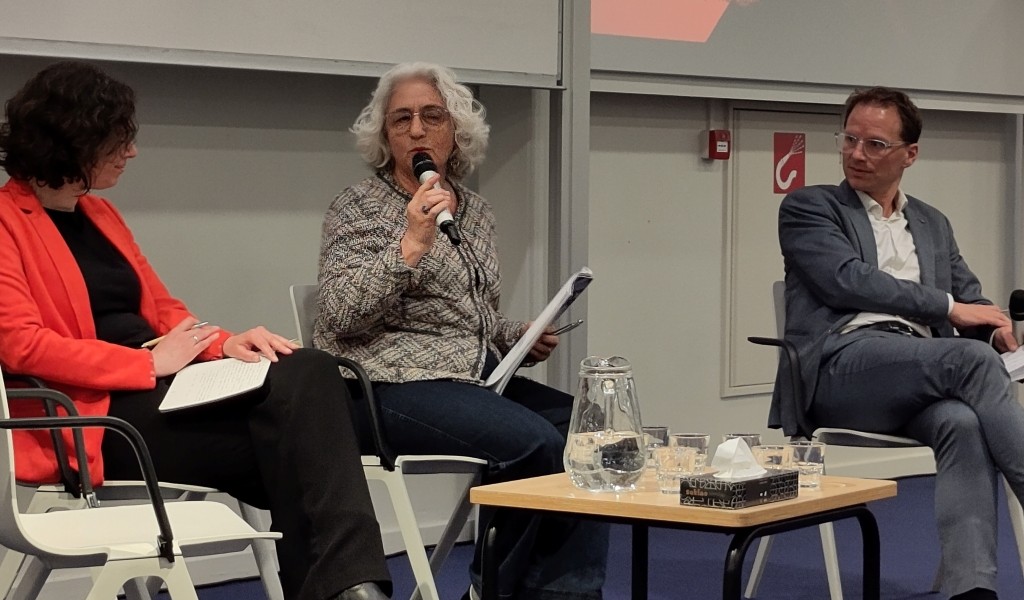
Representatives from politics, civil society and academia discussed the urgent need to address democratic backsliding at the launch in the Hague of a new report by IDS entitled, Where’s the Demos in Democracy? Building Democratic Futures and Resisting Autocracy. The event was co-organised by the International Institute of Social Studies (ISS) and IDS.
Watch a recording of the event
In the face of a globally coordinated backlash on democratic freedoms, speakers pointed to the need for pro-democratic groups to collaborate better – to understand the backlash, to share organising tactics, and to develop stronger narratives in support of democracy.
“Autocratic forces are supporting each other,” said Tijmen Rooseboom, Executive Director, Netherlands Institute for Multiparty Democracy. “Democratic forces must do the same.”
Twin challenges of inequality and service delivery
Whilst democracy has been proven to deliver immense benefits for people in areas such as education and health, one challenge it has struggled to address is inequality. Shandana Khan Mohmand, Research Fellow at IDS, explained: “Addressing inequality is not an automatic outcome of democracy, and people have been really hurt over the last decade [with the cost-of-living crisis].”
In fact, the relationship goes the other way, said Mohmand: “Economic inequality is one of the stronger indicators for where democratic backsliding will occur.” A living wage crisis in the US, for example, has been identified as a key reason for the re-election of President Trump. Explicitly ensuring that democratic governments tackle inequality is therefore a vital part of protecting democracy.
Rukia Cornelius, Civil Society lead for Oxfam Novib also pointed to the need for democracies to bring tangible benefits such as basic services. She pointed to a recent Afrobarometer survey which 53% of Africans would accept an un-democratic government if it could provide security or basic services. “Democracy is not failing as an idea,” she said. “It’s failing in delivery.”
Responding to attacks on democracy
But democracy is not just in crisis because of a failure to tackle inequality or deliver services – it is actively being attacked.
Marianna Belalba, Senior Legal Adviser at the European Centre for Not-for-Profit Law argued that the widespread use of ‘foreign agent’ legislation has been one of the most effective means to weaken pro-democratic actors. This legislation, which has been introduced in countries as diverse as Nicaragua, Georgia and Slovakia, weakens NGOs which are recipients of international funding. “It creates the idea that there is an enemy which you need to control,” she said, noting that groups opposed to the government can easily be depicted as “responding to foreign interests against the national interest – and its very difficult to fight against this.”
Countries that have recently emerged from autocracy are finding it hard to regain democratic freedoms. In Poland, a new government elected in 2023 – after the previous government spent eight years undermining rights – has found it hard to make progress back again, with work in areas such as abortion and judicial independence held up or blocked.
Numerous speakers mentioned challenges at home, in the Netherlands. Joeri Buhrer Tavanier, Executive Director of the Netherlands Helsinki Committee, referenced recent budget cuts to Dutch public broadcasting as an early signal that democracy could be under threat. “Media being targeted – this is often the first thing that happens,” he noted.
Celia d’Almeida, from the Netherlands Institute for Multi-Party Democracy Mali, spoke about the need to take a long-term view of the battle to regain democracy. Mali was subject to a military takeover in 2020, and any hope of the country returning to democracy is further challenged by the geopolitics of the Sahel, with Chinese, Turkish and French groups vying for influence. But she said, “This didn’t happen in 2020. It [the work to undermine democracy] started 30 years ago. Now, we need to build a better conception of what democracy is, and what it means for people. It won’t happen in three or five years – it will take time.”
At the same time, governments seem less interested to efforts to uphold democracy in other countries, said Dirk Jan Koch, Network Chair at ISS. “Over the past decade, we have witnessed a dramatic contraction in financial support for democracy worldwide. But also politically, fewer governments are prioritising democracy support as a core pillar of their foreign policy.”
Oxfam-Novib’s Ruka Cornelius gave three recommendations for how countries in the global South can resist autocracy. Firstly, embrace decolonisation by using domestic governance models, not imported approaches. Second, bring leaders closer to citizens through decentralisation. And third, develop a renewed form of democratic solidarity which can defend and make the case for democracy.
Defending democracy can conjure up images of people protesting. But as Marjoke Oosterom, Research Fellow at IDS noted, not everybody wants to go out and protest – and often its the day-to-day notions of democracy that are the most important. “Where do people learn the practice of democracy? Its in the everyday neighbourhood,” she said. This is a key finding of the new IDS report.
Discover more of IDS’ work on democracy
Polarisation must be avoided
In the struggle to defend democracy, it can be too easy to create narratives which create division and alienation.
Farah Karimi, Member of the First Chamber in the Netherlands, gave a warning about the dangers of polarisation, and the risks of both pro- and anti-democratic groups undermining the viability of elections. There was a worrying trend, she said, of European leaders determining if elections were credible based on who won: “If my political friend wins, ‘its good’; but if they don’t, then ‘its not’.”
She compared the reactions in the EU to the situation in Moldova, where a pro-European government was recently voted into power; with how leaders responded to Georgia, where socially conservative Georgian Dream party, closely aligned with the Kremlin, won the October 2024 elections.
Perhaps the success of democratic systems will lie, ultimately, with extent to which they does genuinely represent the people. Karimi noted the failure of democracy in Afghanistan, where billions were spent by the West over 20 years, but in the end, when the West exited, there was no-one interested in defending it from the Taliban. “If there’s no ownership, whose democracy are we talking about?”
Key contacts