

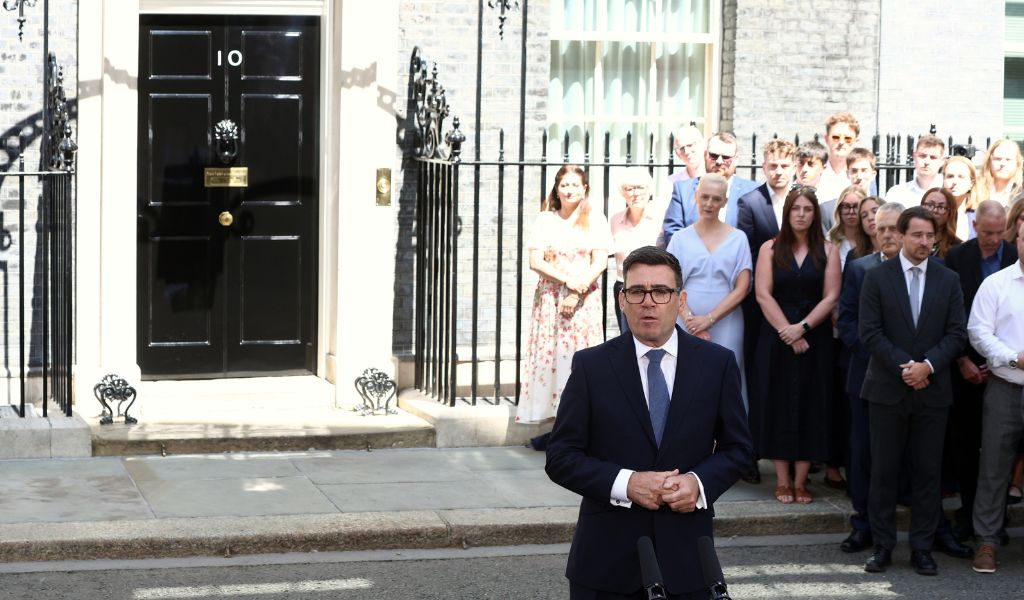
Andy Burnham became Prime Minister with a pledge to decentralise decision-making away from Westminster and into the hands of regions, hailing it as the “biggest rebalancing of power our country has seen”. Putting this policy at the heart of his domestic ‘Manchesterism’ agenda presents an opportunity to give communities greater control over local decisions. It is also an opportunity to tackle political exclusion and therefore one of the most pressing challenges: democratic backsliding in the UK.
Democratic backsliding in the UK
Backsliding is not something we associate with the UK and its robust, institutionalised democracy. But V-Dem’s 2026 Democracy Report identified 10 new autocratisers in 2025, including five European countries: Croatia, Italy, Slovakia, Slovenia, and the UK. The UK’s backslide is largely underpinned by reduced freedom of academic and cultural expression and media self-censorship, especially on the genocide in Gaza.
But we know that trust in public institutions has also fallen. Since the turn of the century, trust in governments, parliaments, and elected representatives has been falling in democratic countries, with more than two-thirds of people worldwide perceiving that they have little influence over the decisions made by their government. The UK is no different. By 2023, confidence in parliament among the British public had halved since 1990, and a record high of 45% said they ‘almost never’ trust governments of any party to place the needs of the nation above the interests of their own political party. Overall, there is a sense of disempowerment and disengagement vis-a-vis decision-making, and these sentiments are often central to democratic backsliding.
It makes sense for Burnham to want to decentralise. Many of the most salient democratic and economic challenges facing Britain today are experienced most directly at the local level, but decisions about them remain highly centralised. Questions of security, social cohesion, economic inequality, immigration, and political polarisation are all lived in everyday local contexts, even if they are often framed as national issues.
Public participation
It is Burnham’s ten years as Mayor of Greater Manchester that has driven his plan for greater local decision-making powers to drive regional growth, housing, schools and roads etc., rather than a mission to strengthen democracy – but he should seize the opportunity to do both. There is a close link between the two. Public services are better delivered through public participation in decision-making – who needs what, where, and how much are decisions that are better made with the beneficiaries of these services. And as decision-making power is redistributed through public engagement, trust in institutions and faith in democratic processes can both grow.
If results roll in, engagement and trust are further strengthened, and as these strengthen, the quality and efficiency of services may also improve. These are mutually reinforcing processes. Our recent report shows that democracy delivers on a range of development outcomes, including education, health, peace, and prosperity.
For Burnham, this can work to speak to the growing concern that the Labour party has not had the interests and wellbeing of working-class voters at heart or in its actions. But this needs to be done right, and not simply as moving power from the centre to regions and cities.
Power needs to move to people.
How to engage decision-making at grass-roots levels
Andy Burnham and his government need to look carefully at how they decentralise power and the systems within which they can engage decision-making at grass-roots levels. Strengthening democracy is not a technical exercise; it includes democratising institutions and processes and requires the actions and behaviours of various actors, such as Mayors and local councillors, to be more representative, inclusive, and equitable.
He has faced a backlash over his latest announcement to give Mayors new powers to overrule local councils on large housing developments, which will result in local communities having less influence over decisions about their area. To help achieve the joint win of decentralising power and protecting against democratic backsliding, this new government should focus on how to build and strengthen active citizenship.
Active citizenship recognises that citizenship does not only refer to having a legal status as a resident of a particular place or country, but to the capability or practice of claiming rights, engaging in decision-making processes, and with public authorities.
Besides tangible outcomes in terms of policy change or state responsiveness, engagement in democratic spaces can generate a sense of rights and citizenship, build practical experience with participatory processes and collective action, and generate alternative visions for those who are often marginalised from decision-making. These are important prerequisites for maintaining or strengthening democratic resilience within society
For example, associations for tenants and those facing housing insecurities build active citizenship and mobilise structures while addressing real material needs.
From how economic insecurity and technological change affect livelihoods and opportunity to how demographic change, social conflict, and gender and ethnic backlash are managed, the quality of local governance can shape trust in institutions and in democracy. But that rests on the actual and effective redistribution of power to people.