
Luíz Inácio Lula da Silva has secured a fourth term as the President of Brazil on the back of an extraordinary last-minute surge of support. Lula’s new term will face domestic and global headwinds, but if he can build on the mobilisation that won him the election and keep his promise to transform the way Brazil is governed, he could help drive a much-needed democratic revival in the Americas and beyond.
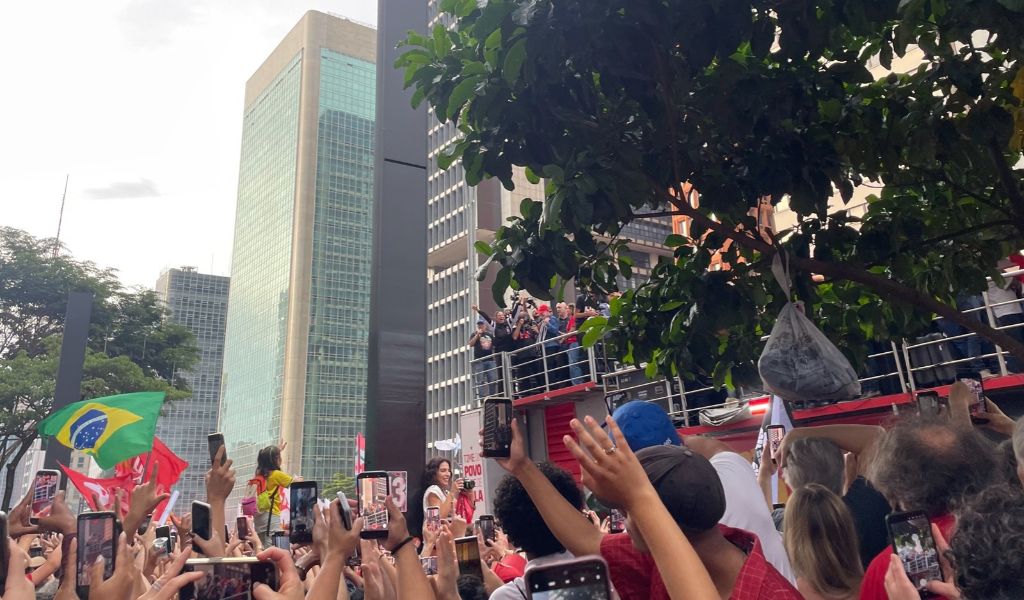
Credit: Alex Shankland
In early October, after the election’s first round, Lula was trailing the Trump-backed far-right candidate Flávio Bolsonaro (son of the jailed ex-president Jair Bolsonaro) by more than two million votes and faced criticism for running an old-fashioned and backwards-looking campaign. The 80-year-old Lula’s style seemed poorly suited to the increasingly online and highly polarised nature of Brazilian politics, which we have been analysing with our partners at Cebrap as part of an international comparative project on Youth, Affective Polarisation and Trust.
Lula’s subsequent election triumph by over 4 million votes reflects a broad-based mobilisation that owed very little to the long-established coalition of elected politicians, trade unions and civil society groups that has long underpinned support for his Workers’ Party (PT). Instead, it appeared to be a mixture of word-of-mouth and viral digital activism that was motivated less by reverence for Lula’s legacy and more by revulsion at the prospect of a Flávio Bolsonaro victory – with threats it would bring to the Constitution and the environment, as part of the authoritarian Bolsonarista project.
‘Lula’s Army’ influencers
The symbol of the digital component of Lula’s second-round campaign was André Janones, a politician who managed to sign up over 10 million people for his ‘Lula’s Army’ WhatsApp channel. He was joined by a new generation of progressive influencers, including Erika Hilton, a member of Congress who is one of Brazil’s best-known trans activists.
Neither Janones nor Hilton is a member of the PT, having been elected to Congress for smaller Left parties. Their emergence as the key digital mobilisers of Lula’s second-round campaign represented a decisive shift away from the PT’s established command-and-control, machine-politics approach to campaigning and the beginning of a new openness on Lula’s part to a more plural, fluid and emergent style of politics – something that proved crucial in winning over people who had voted for other candidates or simply stayed away from the polls in the first round.
This shift generated enough momentum to overcome the heavy digital disadvantage with which Lula entered the second round. It was subsequently aggravated by well-documented algorithm bias in favour of his opponent on US-based social media platforms – most notoriously Meta, which faced protests at its São Paulo office after giving unequal treatment to Facebook accounts linked to Lula and to Flávio Bolsonaro.
Corruption and apathy
Recent corruption allegations against Flávio Bolsonaro seem to have had only limited cut-through with voters, their impact diluted by the scale of a huge scandal over bribery by a banker that has implicated allies of Lula as well as far-right politicians. This scandal has helped to entrench a mix of scepticism and apathy among large swathes of the Brazilian electorate that is apparent everywhere in Brazil – including here in the neighbourhood of São Paulo where I am staying during a spell as a Quality of Governance Research Centre Visiting Fellow with our partners at Fundação Getúlio Vargas.
On Saturday, as I waited for the bus to Avenida Paulista for Lula’s final rally of the campaign, the other people waiting at the bus stop were a young middle-class white couple with their baby and three older Black working-class people. The Lula T-Shirts were being worn by the middle-class couple (and their baby’s matching PT red T-shirt), while the three working-class people – two women and a man – were talking in a weary tone about their frustration with Lula’s ‘broken promises’, his failure to contain the rising cost of living, and the sense that politicians were ‘all just in it for themselves’.
Positive picture undermined by cost of living
To an outsider, this lack of faith in Lula’s ability to deliver may seem extraordinary – after all, he is one of the world’s most respected statesmen whose governments have generated robust economic growth, reduced income inequality and took Brazil off the World Hunger Map not once but twice (the second time after he returned to power following Jair Bolsonaro’s disastrous presidency). His government has shown global leadership on climate change while also bringing Amazonian deforestation down to its lowest levels in decades.
However, for many Brazilians this positive picture is undermined by the squeezed living standards that are causing discontent the world over. This is coupled with concern at the rising power of organised crime and the endemic violence that has led many people to support the Bolsonaristas’ militarised, human rights-denying security agenda.
Political headwinds
These concerns have been weaponised by Trump-aligned politicians throughout Central and South America, helping to entrench would-be strongmen such as Javier Milei in Argentina and Nayib Bukele in El Salvador. They also propelled right-wing candidates over the line in closely fought elections in Peru and Colombia.
During his campaign, Lula called out his rival’s closeness to Trump – including Flávio Bolsonaro’s promise to hand over Brazil’s globally important reserves of critical minerals to the US. But the narrowness of Lula’s victory means that it can hardly be seen as a resounding repudiation of the ‘Donroe doctrine’.
Lula will start his fourth term facing not only right-wing regimes across Latin America and a hostile US administration, but also a very adverse political landscape at home. Bolsonarista candidates won the largest number of State governorships and seats in Congress and the hard right may just muster enough votes in the Senate to impeach Supreme Court justices and block key government appointments as part of a campaign to secure Jair Bolsonaro’s release.
Doing democracy differently
Faced with a Congress dominated by Bolsonaristas who favour polarisation over negotiation, Lula will not be able to rely on the deal-making that allowed him to push through pro-poor reforms in his previous terms of office. He will need to adopt a very different style of governance. Including radically renewing his policy agenda, which is widely seen as repeating the same prescriptions for Brazil’s problems despite the huge changes the country has experienced since Lula first became President.
Compared to when he first entered office almost a quarter of a century ago, Brazil’s population is now – largely thanks to his policies – more highly educated and less food insecure, but also more individualistic and more dependent on the gig economy.
New priorities and ways of working
This requires very different government priorities and a very different way of doing participation. The long-established institutions of Brazilian deliberative democracy, such as sectoral policy councils and participatory budgeting, have been stagnating for many years, but Lula’s most recent term in office saw little in the way of innovation. Lula restored many of the participatory institutions dismantled by Jair Bolsonaro, but little was done to refresh their ways of working and rebuild their legitimacy with constituencies who no longer organise in the traditional social movement style.
Lula’s victory has won a breathing space for Brazilian democracy – and what happens next has implications that extend far beyond Brazil. If his final term can incorporate the blend of online and offline political engagement, and the new ideas and new voices from the final phase of his re-election campaign, then he may progress Brazil’s current challenges. If he can do this successfully enough to start moving Brazil beyond its current mix of weary scepticism and entrenched political polarisation, he could contribute to a much-needed democratic revival across Latin America and beyond. That would be a truly worthy final component of Lula’s already remarkable legacy.