
A Bowl of Love / Một Bát Thương exhibition will be hosted at the Vietnamese Women’s Museum in Hanoi, Viet Nam starting 12 November 2026 until 30 November 2026.
This interactive exhibition brings together contemporary art, traditional Vietnamese makers and social science research on gender-based violence against women.
A Bowl of Love / Một Bát Thương, hosted by the Vietnamese Women’s Museum, is part of the research programme ‘Lost Souls, White Bowls: Documenting Vietnamese Femicide’ led by the Institute of Development Studies. The study analysed reports of 437 killings of women and girls in three national Vietnamese news outlets from 2018 to 2024 and identified 346 of them as femicide.
The exhibition combines four approaches to understanding gender-based violence: visual art, thinking and making through materials and concepts; artisanal material knowledge passed through generations; the systematic analysis of social science; and individual women’s experience of gender-based violence, through their work or their own lives.
What to look for in the exhibition
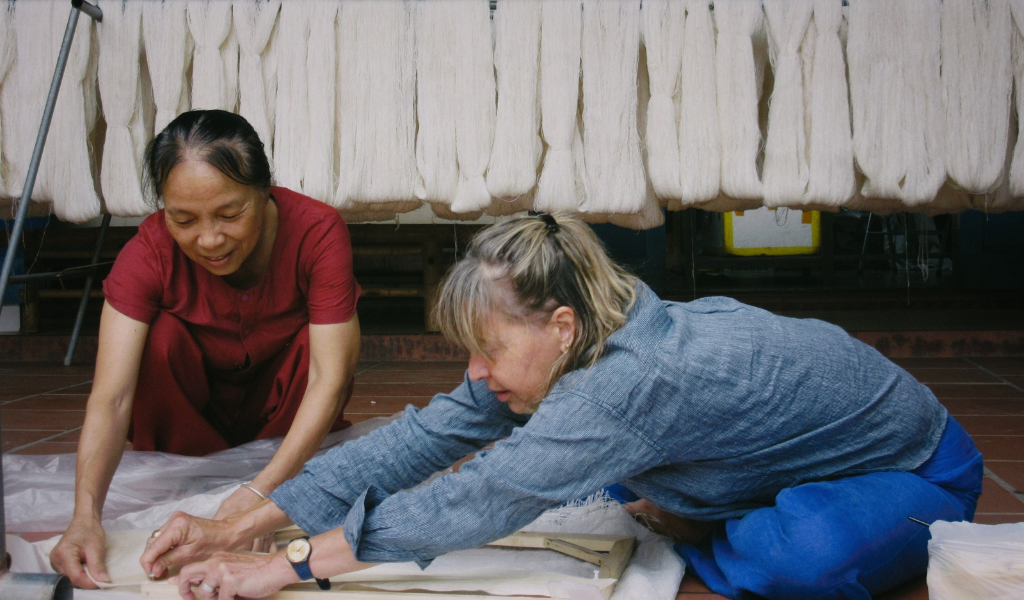
A Bowl of Love comprises seven interlinked contemporary art works. Researcher and visual artist Pauline Oosterhoff, the programme’s Principal Investigator, collaborated with 12 Vietnamese makers: artisans working in silk, ceramics and votive paper metalworkers, furniture makers and a documentary filmmaker. Together, they explored new applications of traditional techniques, materials, and approaches.
The exhibition shows fortified Bát Tràng clay holding the imprints of women’s backs and the stories they carry. Handwoven silk bears bold, graphic paintings. Metal and wood, freed from function, become means of expression. Papier-mâché, bamboo frames and votive paper find unexpected shapes. And among them is a, large memorial bowl bearing the names of the 346 women, their children, the unborn and the other who were killed with them. The collaboration varied from work to work. Sixteen prominent Vietnamese women who were lawyers, journalists, researchers, child-rights advocates and social workers, some of them survivors of violence themselves, co-created the clay backs and individual bowls.
The exhibition also presents a short film directed by by Nguyễn Ánh, in which each woman created her own set within a format of fixed elements. Each shared her experiences and decided how much of herself to reveal. The exhibition does not recreate violence through shocking imagery but invites visitors to reflect, remember, and engage directly with the works.
Pauline Oosterhoff, Senior Research Fellow at the Institute of Development Studies and the Programme’s Principal Investigator said:
“My artworks often both memorialise and celebrate life”
“I am looking for different perspectives on human relationships, which I see as inherently unstable and complicated. As an anthropologist, I know that every aspect of human existence is lived somewhere in a way that may be incomprehensible to others. As an artist, I am trying to find a way out of what art historian Claire Bishop calls the ‘artificial hells’ of participatory art. Where I carry the artistic responsibility, I want clarity when others take part: the people I work with come in at specific moments, each their own role, using their own expertise and able to decide what they share, how, and whether at all.”
Nguyễn Thị Tuyết, Director of the Vietnamese Women’s Museum said:
“Accompanying the research team in organising this exhibition is profoundly meaningful and clearly reflects the Museum’s mission to represent the stories and pulse of contemporary life. Through the exhibition, the Museum hopes to create a forum that connects the public around issues concerning women. By bringing the language of installation art together with the familiar materials of Vietnamese culture and the knowledge they carry, the exhibition opens an interactive space where each person can feel, understand and join with others in creating positive change”
Dr. Hoàng Tú Anh, Director of CCIHP and Co-Principal Investigator said:
“This is a very challenging subject and one that is often avoided. Approaching the families of those who have died is extremely difficult because of the depth of their grief. Many people have asked us about the 346 cases identified through media reports and included in our research, questioning their legitimacy because they are not official national statistics. Yes, they are not national statistics, but they are real people and real lives.
“Media review is also a method recognised internationally. I also want to emphasise that this figure represents only the tip of the iceberg. Even in developed countries such as Germany, Denmark and the Netherlands, cases reported in the media represent only around 50% of incidents that actually occur. Conducting this research has also been very challenging because of its emotional impact on the research team itself. We hope that in this exhibition, the visitors will interact, feel and act towards a more humane and equal society.”
This interdisciplinary exhibition brings together social science research, documentary film, contemporary art and the practice of Vietnamese artisans. Each discipline has its own research traditions which informed this exposition.

