

To mark World Food Day, Verity Hobbs, MA Food Systems & Sustainable Development student (class of 2027), explores a landmark court ruling in Kenya that affirmed smallholder farmers’ rights to save, share and exchange seeds. Drawing on the wider debates around seed sovereignty, food security and agricultural justice, she highlights how collective action by farming communities challenged restrictive legislation and offers powerful lessons for building more resilient and equitable food systems.
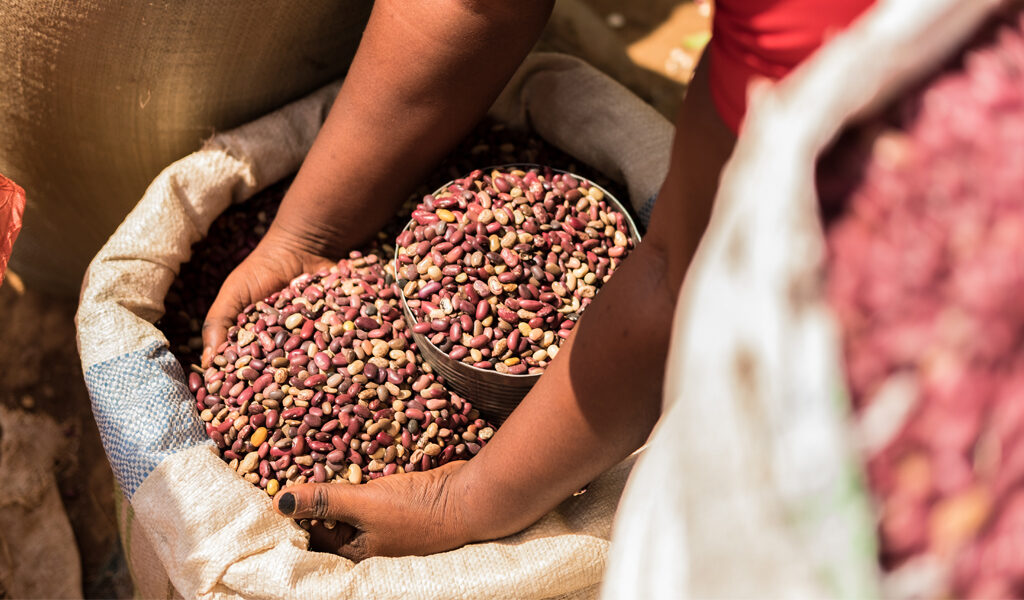
Faced with legislation that restricted traditional seed-saving and exchange practices, in 2022 Kenyan farmers came together to challenge the law. Their successful court case offers a powerful example of how community resilience and collective action can drive change, even in the face of powerful institutions.
On the 27th of November 2025, a Greenpeace headline stated, “HISTORIC VICTORY: Kenyan Court Rules ‘Sharing Seeds is Not a Crime’ in Landmark Verdict for Food Sovereignty”. This press release signalled a long-awaited verdict that deemed the Kenyan state’s 2012 Seed Law (The Seed and Plant Variety Act, Cap 326) unconstitutional in its treatment of smallholder farmers. The case was brought by fifteen smallholder farmers from the Seed Savers Network Kenya, who challenged the state for criminalising traditional seed practices that have sustained the livelihoods of rural communities for generations.
Reflecting broader agrarian struggles, the legislation challenged in the case is part of a wider system of global seed governance, which has restricted farmers’ rights for decades – the International Union for the Protection of New Varieties of Plants (UPOV 1991). This framework favours commercial varieties that are prioritised for international trade. But, through the prohibition of unregistered varieties, the policies subsequently marginalise smallholder farmers, and criminalise the diverse, locally adapted seeds that sustain many local economies.
Conforming to such rigorous and exclusive policies raises important questions about who benefits from these systems, particularly when considering that two seed companies control 40% of global seed market. It also raises the concern of who is left out – highlighting the structural hierarchies which determine how seed is defined, regulated, and circulated.
Local seeds are local economies
Under the 2012 Seed Law, swapping seeds with a neighbour or selling seed at a local market suddenly became an illicit act. Farmers faced up to two years imprisonment and a fine of 1 million shillings (£5,700 GBP) for exchanging seeds, many of which were locally adapted varieties such as sorghum, millet, and other nutrient-rich crops suited to regional climates. These crops are central to rural economies, and their high value means that they are often exchanged as a form of community currency. By criminalising unregistered seed, Kenya’s seed law overlooked the role of farmer-managed networks and their seeds as a form of insurance against crises including injury, illness, and the increasing prevalence of drought.
In some cases, the criminalisation of seed could also affect the sale of produce itself as there is ambiguity surrounding the definition of ‘seed’, which includes the part of the plant which will be propagated – this also includes tubers and grains. For example, if a tuber can be propagated, then a potato crop is also legally precarious, as it’s both a crop for consumption and a tuber for planting. If sold side by side at a rural market, there is no way to determine that a potato is purely sold just for consumption. This is the same for corn, wheat, rice (grains), cassava, and sweet potatoes (tubers). Without clear exceptions for this common overlap, farmers markets, which provide essential food security, could also be deemed as illicit.
The financial exclusion of registered seeds
Even if farmers tried to comply with the law and register their locally adapted seeds, testing itself is expensive alongside travel costs to nation-wide testing centres. This rigorous process has contributed to a monopolisation of the global commercial seed industry, with just four corporations controlling more than half of annual global seed sales.
This exclusionary system has also facilitated the theft of locally adapted seed. An indigenous Buffel Grass variety, for example, was registered in a way that prevented rural communities from producing and exchanging a seed they had cultivated and maintained for generations. Once registered, the seed became financially inaccessible to many of the farmers who had originally developed it.
A recent study, which interviewed members of Community Seed Banks across Kenya, found that 56% of interviewees shared that commercially-registered seeds were three to five times more expensive than unregistered local seeds. 34% reported delaying planting or reducing acreage when planting commercially registered seed, so even when trying to comply with seed legislation, farmers found themselves at an economic loss. This pushed smallholder farmers into a catch-22: adopt expensive commercial seed as a risky financial decision (if able to purchase in the first place) or continue exchanging criminalised local seed and risk legal consequences.
In addition, many hybrid seeds need to be bought again each season, tying farmers into repeated purchases of both seed and associated agrichemical inputs such as fertiliser. This further accumulates significant debt for farmers and increases their reliance on monocultural production, as diversifying commercial crops would be too expensive. Subsequently this reduces crop diversity, damaging both the land and rural health, creating a detrimental landscape for future food security.
Local seeds: Fundamental for our future
In the face of climate change, locally-adapted, unregistered seeds offer an important source of resilience because they have evolved alongside the specific environments in which they are grown. Meanwhile, the lengthy testing and registration process set out by global seed governance means that seeds entering the commercial system can take years to be approved, while climatic conditions continue to change at a much faster rate. This means that significant ecological risks are taken when turning to commercial monocultures, as they are reliant on genetics that have had a delay in adaptation.
The risks here became clear through a case in Kenya’s North Rift region, where over 200 acres of commercial maize monocultures failed during the dry rainy season of mid-2023, as the standardised varieties were unresilient to extreme localised weather conditions. By contrast, indigenous varieties stored in community seed banks often outperform certified seeds, as one farmer in a recent study explained, “these seeds may not look uniform, but they survive here where the certified ones fail”. The exchange of seed between rural communities expands genetic diversity, while Community Seed Banks and farming networks provide spaces for knowledge exchange and seed preservation, helping to rebuild biodiversity in landscapes increasingly reliant on monocultural agriculture.
Smallholder farmers and their locally-cultivated seeds are pillars of global food security and cannot be dismissed as insignificant networks in need of regulation. The 2025 Kenyan court ruling, therefore, represents more than a legal correction to national policy; it constitutes a broader challenge to the assumptions underpinning UPOV-aligned seed governance – whereby David fought Goliath and won. In this sense, I hope that this case serves as an example for communities around the world. Farmer-managed seed systems are not merely surviving alongside commercial structures – they are politically active in their resistance to global orders, exposing weaknesses within these structures that will inherently affect the security of our future.
Elucidating the importance of these seed systems is not only an academic necessity but is a politically moral one, central to rethinking how agricultural futures are governed across the globe. And whilst the ruling concerns seed systems in Kenya, its significance extends beyond agriculture. It demonstrates how communities can organise collectively to challenge policies that affect their lives. At a time when many people feel powerless in the face of large institutions and global systems, the case offers a reminder that meaningful change often begins through collective action at the local level.
Verity Hobbs is currently pursuing an MA in Food Systems and Sustainable Development at the Institute of Development Studies. Find out more about this degree: