

The world is witnessing a rise of the right-wing. A common thread uniting many of these groups is their anti-migration agenda. Politicians such as Marine Le Pen, Donald Trump, and Alice Weidel have built entire platforms and gained significant support by promoting negative narratives about immigrants: they’ll steal your job, bring crime, and destroy ‘our’ culture. These anti-immigration stances often resonate with radical right-wing voters, even more than economic or political concerns, as they tap into deep fears about identity, security, and national sovereignty.
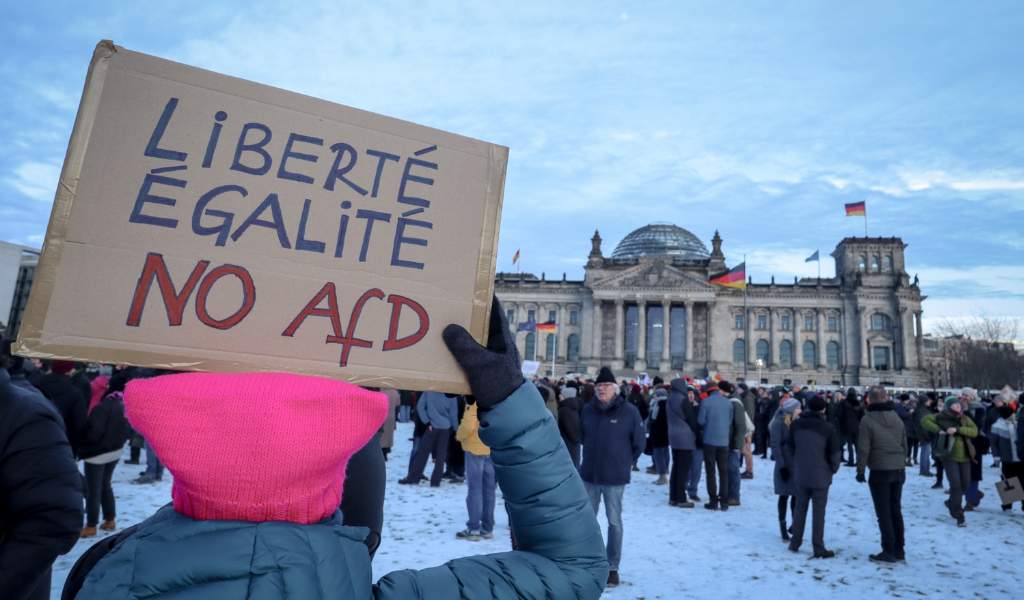
Germany offers one of the clearest examples of how migration policies have reshaped the political landscape. Today, the Alternative für Deutschland (AfD), a party that defines itself as conservative, has become the country’s second-largest political force, winning a record of 152 out of the 630 seat parliament and steadily increasing its popularity. Equally striking is the decline of the support for the Christian Democratic Union of Germany (CDU) and Christian Social Union in Bavaria (CSU) alliance, which has dropped from 41.5 percent of the vote in 2013 to 28.5 percent in 2025.
This shift can be traced back a decade, when an open-door refugee policy—initially framed as a humanitarian commitment—produced a political backlash that fuelled the rise of the extreme right.
Merkel’s Wir schaffen das policy
When the Arab Spring occurred, hundreds of people were looking for asylum, driving a historic wave of migration to Europe. The situation quickly escalated into a humanitarian emergency, as existing infrastructure was inadequate to manage the sudden and large-scale influx of people. Simultaneously, Germany was facing a different challenge: a rapidly aging population and increasing concerns about a shortage of skilled labour, issues that were drawing significant political and media attention.
Within this context, in 2015, ex Chancellor Angela Merkel announced an open doors policy to welcome a large number of refugees. Merkel’s famous phrase, “Wir schaffen das” (“We can do this”), captured the spirit of a policy that was both humanitarian and pragmatic, aiming to achieve two things:
- Uphold its humanitarian values by providing a compassionate response to a crisis.
- Address labour shortages by welcoming potential workers since most refugees were young people.
In October 2015, the Bundestag (Germany’s parliament) approved a set of measures designed to support refugees. This included monthly financial support to refugees, new social housing, access to temporary jobs, and health cards for immediate medical treatment. Germany also contributed to the suspension on some EU rules restricting refugee entry, boosting Angela Merkel’s leadership during this period, and even being named “Person of the Year” by Time magazine.
From welcoming culture to backlash
Ten years ago images of Germans welcoming refugees at train stations made headlines worldwide, symbolising compassion and solidarity. In 2015, nearly half of Germans volunteered to support refugees, but this enthusiasm was short-lived. Shelters soon became overcrowded, benefits started being inconsistent, and EU partners reinstated border controls. In addition, reports of sexual assaults during New Year’s Eve celebrations by ‘North African-looking men’ fuelled public fear and resentment and violence against refugees also surged. Attacks on asylum seekers and refugee shelters had already been rising, but in 2015 and 2016, the number of incidents surged.
Therefore, the open-doors policy quickly became politically contentious. Facing state elections, in February 2016, the Bundestag approved restrictions to the initial benefits, limiting free movement of refugees around Germany, reducing maintenance transfers, health care. It also excluded new protections for women and unaccompanied minors. Moreover, refugees could even face sanctions, for instance, if they failed to attend language and integration courses. Yet the demand far outpaced supply, leaving around 200,000 people on waiting lists due to a shortage of classes and instructors.
Rise of the far right
Far-right movements acted quickly. Patriotic Europeans Against the Islamisation of the West (Pegida) and the political party Alternative for Germany (AfD) mobilised people against refugees, even though this was not at the core of their ideals. AfD was founded in 2013 (before the open doors policy) with the aim to disengage from the EU. To start with it was not popular, but this changed with the refugee crisis. The party shifted its discourse to mainly anti-migrant, having protectionist and nationalist extreme ideals at its core. In less than two years after welcoming refugees, the AfD secured 94 seats in the Parliament, becoming the first far-right party elected to the Bundestag since the 1960s, and making it the largest opposition party at the time.
The supportive and welcoming narrative by politicians started to shift into a more restrictive and contradictory one. Merkel’s popularity was falling, and her own party allies began pushing for stricter limits. Then, Germany led the European Union-Turkey deal with the purpose of closing the EU–Türkiye border. This brought a selective logic that divided refugees into “wanted” and “unwanted”, giving preference to Syrian refugees – who tend to be well educated and qualified – to be welcomed to Germany, while refugees from other countries were not.
This arrangement transferred responsibility for most asylum seekers to Türkiye, bringing even more uncertainty about their future and exposing them to greater risk of human rights violations. The agreement stated: ‘Türkiye will take all the necessary steps to fulfil the remaining requirements’.
This shows how wealthier countries can outsource the “rule of law” when necessary to accomplish their objectives while preserving a humanitarian image, echoing Charles Tilly’s observation about how great powers export war, or in this case, conflict, to the rest of the world.
Short-term versus long-term goals
Germany’s ‘welcome culture’ offered a rare glimpse of more inclusive and supportive refugee reception policies in Europe. However, this approach lasted only about five months before political pressures led the government to adopt a more restrictive stance. Due to the brief welcoming phase of the policy implementation, it is difficult to assess its long-term effects on refugee integration, social cohesion, and political attitudes. A longer period of sustained openness might have offered valuable insights into how rich countries with consistent and supportive policies could shape refugee outcomes and reshape public discourse around migration.
Germany’s initial open-door policy quickly gave way to political backlash, societal tensions, and restrictive shifts in policy. The dramatic rise of the far-right AfD reveals how fragile solidarity can be when challenged by fear, nationalism, and the limits of European cooperation.
However, the problem was not the open-door policy, but rather the state’s lack of capacity and willingness to reduce the challenges involved in integrating refugees into a whole new society. Policies require time to take root—especially when supporting individuals who may carry the trauma of violence and displacement. It’s naïve to expect that everyone will ‘behave’ and that no incidents will occur. Instead of reducing the support for refugees to try to counter the far-right politicians, constant monitoring of how to approach unforeseen circumstances was necessary, as well as continuous political communication with the population.
The AfD took the chance (as opposition parties do) and capitalised on anti-migrant narratives as an easy tool in a context where policies implemented are failing. This case shows how, when faced with electoral pressures, politicians prioritise staying in power over fulfilling their own commitments, which in the end is the reason they could lose. It also shows how short-term political calculations can destroy long-term policy goals, eroding both public trust and the values a society claims to uphold.
Carmen Barrera Degante is a recent student at IDS, studying for an MA in Governance, Development and Public Policy.