


On 7 July 2025, our research project, DISHED, a UKRI-funded initiative to test the piloting of public restaurants in Nottingham and Dundee, was announced. The following day, the Daily Telegraph published a full-length article headlined “WWII-style restaurants to help feed poor families?” By 12 July, readers had left 160 comments. A further article on 11 July on “Labour’s ‘ludicrous’ state-funded restaurants plan sparks backlash”, generated 1,666 more.
Reading them was instructive. Not for what they said about public restaurants, but for what they disclosed about the ideological milieu within which any attempt to reframe food as a collective, social concern must now operate.
“Some parents who cry ‘child poverty’ should be given lessons in housekeeping.”
“Just cut back on fags, booze, tats, dope.”
“What the hell is wrong here; why can’t people go to Lidl and buy decent food and cook their own meals?”
These were not fringe views; they were the most-liked comments: not merely posted but applauded and amplified.
What DISHED is proposing
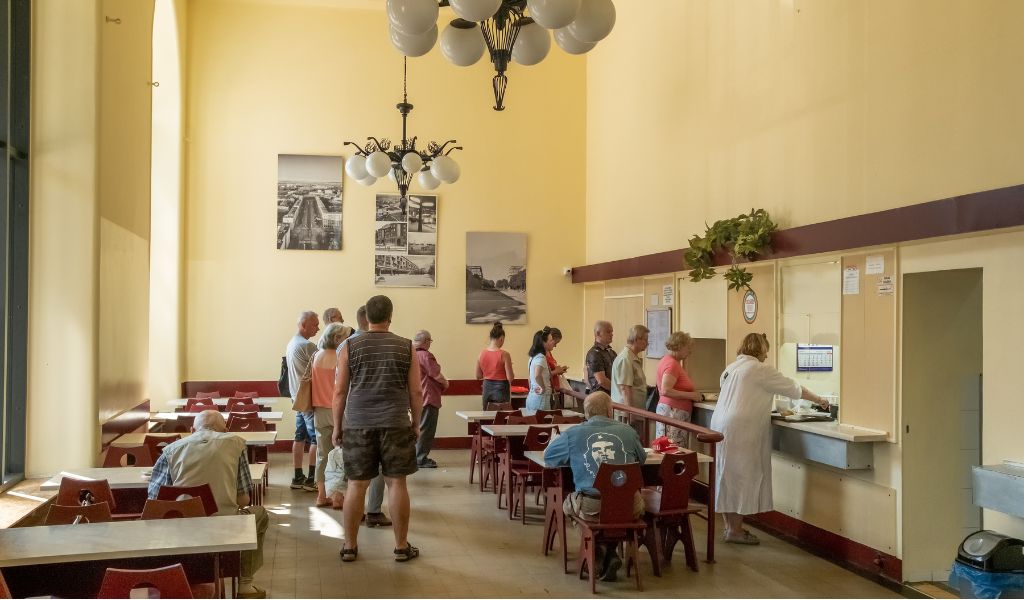
What the DISHED project is proposing in structural terms, is on first sight uncontroversial: a subsidised restaurant, with a low-cost, nutritious meal, open to everyone. Predicated on the notion that access to good food is a legitimate social concern rather than solely a commercial transaction or charitable disbursement. A form of public infrastructure, not unlike public transport or leisure centres.
This model is neither new nor foreign. The British Restaurants of the Second World War, over 2,000 of them by 1943, operated on precisely this logic. Poland’s state-subsidised milk bar network, Bar Mleczny, has been a fixture of everyday life since the 1960s. Istanbul’s Kent Lokantası network, launched in 2022, now operate across multiple Turkish cities. Similar models are being proposed in Germany and the Netherlands. What connects these is not their institutional form but their operational logic: universality of access, social rather than commercial pricing, the symbol of the shared table as a civic rather than a charitable act.
Povertyism and culinary responsibilisation
The comment threads were not, however, presented with this evidence in the Daily Telegraph articles. They were performing what media and poverty scholars term ‘povertyism’: the persistent discursive construction of poverty as an individual moral weakness or failure, rather than a structural inequality. And within that broader discourse, the comments mobilised a specific and telling variant: what my colleagues and I have termed culinary responsibilisation. That is the moralising overemphasis of thrift and domestic cooking as the only appropriate and sufficient responses to food insecurity: “Use cheap cuts of meat (such as mince) and pad it out with onions and kidney beans. Try pasta with homemade tomato sauce (a tin of chopped tomatoes, some onion, and a stock cube).”
Beneath the cooking-skills argument lay a disciplinary logic: that hunger is not a structural condition but an incentive, and that removing it removes the compulsion to work. Commenters insisted that those experiencing poverty needed educating: “If an underprivileged family of 4 can’t cook a nutritious meal for something between £12 and £20 they need educating on the basics of life and regaining self-respect, not going out to a subsidised restaurant every night.”
Race and class
A significant and recurring subset of comments also invoked racialised and nationalist tropes, intertwining fiscal moralism with explicit hostility towards migrants and minority communities.
Comments also surfaced a nakedly classed imaginary of the undeserving poor: ‘Money spent on crisps, rubbish food, instant food, sugary fizzy drinks.’ And: ‘The Nationalised [sic] Restaurant can get an illegal migrant (who isn’t allowed to work) to deliver the meals on a stolen bike, using a stolen phone.’ Such comments do not merely express prejudice; they actively construct an affective register of contempt, classed, gendered and racialised, in which the imagined beneficiary of public food provision is rendered simultaneously pitiable and culpable, lazy and indulgent. These are not peripheral to culinary responsibilisation; they are its racialised and classed underside.
Why this matters?
What was almost entirely absent from thousands of comments was any acknowledgement of the actual conditions within which families on low incomes feed themselves: the time poverty of shift work and precarious employment; the inadequate kitchens of temporary accommodation; the energy costs of cooking from scratch; the cognitive and emotional labour, documented in detail by feminist food scholars, of managing a meagre household budget. That this labour falls disproportionately on women, and that an evening of not having to perform it might be experienced as a legitimate form of relief, was invisibilised under the slew of commentary condemnation.
As scholars argue, media discourses do not merely reflect prevailing sentiment; they actively fabricate the discursive environments within which policy becomes or does not become thinkable. The Telegraph articles on DISHED had already set the framing before a single comment was posted: mis-describing our research budget, positioning a universal infrastructure as a welfare measure for ‘poor families’, and inviting readers to judge its imagined beneficiaries accordingly.
The real-world consequences are not trivial. For DISHED, the backlash consumed significant research time and contributed to the withdrawal of a partner organisation. But the broader consequence is the pre-emptive delegitimising of collective food provision, so that it cannot be apprehended as anything other than charity, and charity of a particularly dubious kind.
Whose dining out?
There is a structural argument here that the comment threads, and the media framing which preceded them, are designed to foreclose. In the UK in 2020, the Treasury’s Eat Out to Help Out restaurant subsidy scheme spent over £800 million; demonstrating a political and public appetite for subsidised dining. The question is not whether eating out can be a legitimate object of public investment. Instead, it is whose eating out, and toward what ends.
The culinary responsibilisation discourse that saturated these comment threads positions food insecurity as a problem of individual moral and domestic failure, resolvable through instruction, self-discipline, and planning. It erases the structural determinants: stagnant wages, precarious employment, welfare retrenchment, sustained food price inflation, that scholarship consistently identifies as the key drivers of rising food insecurity in the UK. It accomplishes this erasure by redirecting attention to the kitchen, the shopping trolley, the mother who allegedly fails to manage her household correctly; relocating the problem from the state, where it belongs, to the individual, where it can be moralised.
Against this, a publicly funded restaurant is not a handout, it is a challenge to the paradigm itself: a material insistence that access to affordable, nutritious food is not a privilege to be earned through correct domestic behaviour, but a condition of social life worth investing in.
The challenge is not just to design good public restaurants, it is to contest, persistently and strategically, the discursive terrain within which such designs are received.