If you live in the United Kingdom in 2026, you do not have a right to adequate food.
You do if you live in India, which joined the International Covenant on Economic, Social and Cultural Rights (ICESCR – which contains the human right to food) in 1979 and has subsequently recognised the right to food in its constitution and in a legally-binding set of programmes and policies grounded in the law. You do if you live in Mexico, which in 2024 enacted the General Law on Adequate and Sustainable Food to operationalise its constitutional mandate and its ratification of ICESCR in 1981. You do if you live in the 30 countries – from Belarus to Zimbabwe – which have explicit constitutional protections for the right to food.
But not in the UK, which ratified ICESCR in 1976 but has never incorporated it into UK domestic law in the way that other countries have, leaving the right to food unwritten and unenforceable. This is partly due to our very unusual (unwritten) constitution, but it is partly a choice made by successive governments.
For example, the Human Rights Act (1998) brings the European Convention on Human Rights (1950) explicitly into UK law but this focuses mostly on civil and political rights, which indirectly support the right to food but don’t directly address it. (This is different in Scotland, which has its own legal system with much stronger human rights provisions, with proposals for a Human Rights Bill that would explicitly protect social and economic rights including the right to food, as noted recently by the UN Special Rapporteur on the right to food.)
The situation is not missed by the global bodies that monitor states’ compliance with human rights treaties. In assessments of the UK’s fulfilment of its ICESCR duties, a series of right to food and food poverty issues have been highlighted by the UN Committee on Economic, Social and Cultural Rights, but representatives of the UK government have not had a ready response.
The UK Right to Food Commission
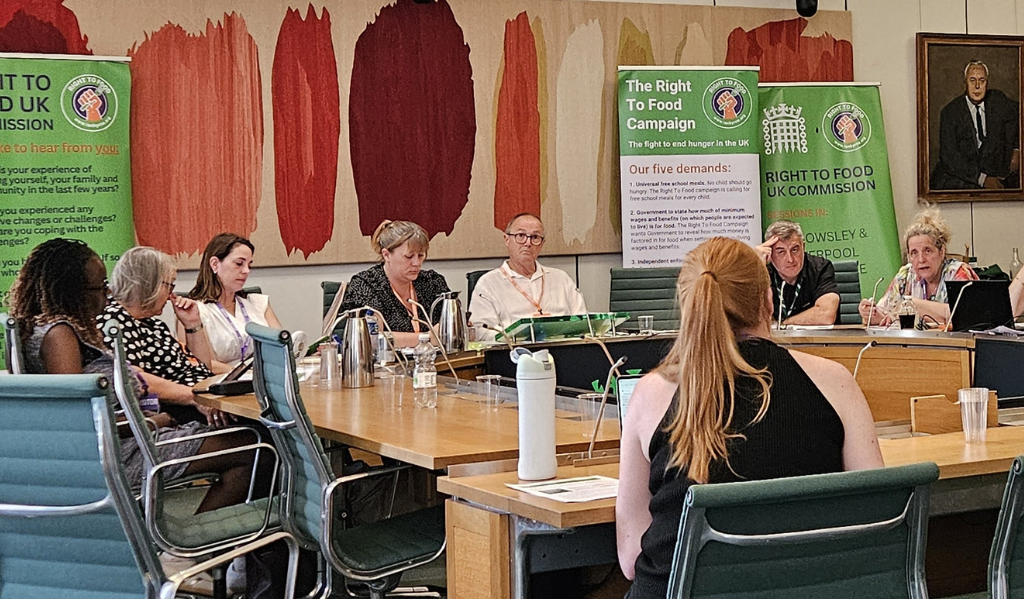
Finally though, there may be a response. In November, 2025, the UK Right to Food Commission was formally launched to look into this enormous omission in UK law and policy: both what to do and how to do it. Headed by Liverpool MP Ian Byrne, it has so far taken public evidence at meetings across the country, and in July 2026 convened expert meetings in Parliament to take stock of this evidence and chart a way forward. These expert meetings heard from food and poverty experts, economists, and representatives of the Department for Work and Pensions (DWP) and the Department for Environment, Food and Rural Affairs (DEFRA), on options for action and practical implementation.
What to do: A focus on cash, rather than food
Across the public evidence and expert opinion, there was significant consensus on what needs to be done in practice to improve food security in the UK. Because of the way that most people obtain food in the UK – by buying it – there is a significant focus on a ‘cash-first’ approach, making sure that everyone has the ability to afford a decent diet.
This mirrors work done internationally on the cost of a healthy diet, which finds that 3 billion people globally cannot afford the foods they need for health at local prices. Broadly, there are two ways to make food affordable: Make food cheaper or make incomes higher. UK farmers are already squeezed by supermarkets and world events that have made raw material more expensive, so there is only so far that reducing prices can go. The use of food banks are another way that households can access affordable food. But emergency food aid, even community kitchens, does not solve the structural issues in ways that protect people’s dignity, as a human rights approach would require.
So, making sure that incomes are adequate to afford food is the major policy lever available to address food insecurity in the UK. This could be through decent wage policies, broader help with the cost of living through keeping bills and taxes fair, and ensuring that social welfare payments consider the cost of food among a basket of goods. Currently, for example, the disability benefit system is not fit to support food security, as reported by the recent Timms Review.
How to do it: A Framework Law to drive policy response
In 2021 the UK government-commissioned National Food Strategy was published, and in 2025 DEFRA released the Food Strategy for England – but neither is legally binding, and any subsequent government can choose to drop these without fanfare. While the unwritten nature of the UK constitution and the sovereignty of Parliament (where no Parliament can bind its successors) mean that no rights can be permanently entrenched in UK law, rights can be enshrined in ways that mean they are enforceable in court, and public authorities are bound by them (for as long as the legislation exists). One option to strengthen the right to food is therefore to pass a law such as this.
Framework laws are foundational ‘umbrella’ statutes for a specific issue, such as the right to food. While it wouldn’t lay out everything necessary to achieve a right to food, a framework law could set targets for outcomes and issues such as government spending, driving the imperative to monitor progress, and strengthen accountability. Crucially, subsequent government policy would have to be ‘benchmarked’ against the law, making sure that new policies would progressively realise the right to food (or at the very least would not regress it). A framework law binds government to the goal, while leaving flexibility on the route.
Framework laws are not a panacea, there still needs to be political will and secondary legislation and meaningful enforcement, but they provide a legal basis for assessing policy action, and for building supportive structures. Thinking ahead, the structures that address food in government, such as the inter-departmental Ministerial Food Strategy Group (chaired by DEFRA) would also need to be reoriented. Implications for devolved and local governments will also be crucial.
Moving forward on the right to food in the UK
Given the pace of change in UK politics, there are both opportunities and barriers to introducing right to food legislation now. The UK government has in the past implicitly confirmed its support of a right to food on the international stage; and domestically, the new Labour government clearly has social justice goals, including the cost of living. The new Prime Minister has also backed a right to food in his previous roles.
Perhaps these are windows of opportunity for a new Bill. The Right to Food Commission is supporting the early drafting of this legislation, with a view to being ready when the window opens. At the same time, there are opportunities to connect to global efforts, such as the European Citizens Initiative on the right to food, or supporting a UK visit from the Special Rapporteur on the right to food.
The right to food is important in itself, and also as a lens onto broader economic, social and cultural human rights. As the Right to Food Commission says, Britain does not have a food shortage, Britain has a wealth distribution problem – and it has for too long accepted food insecurity and hunger as an unavoidable consequence. The next step is to move from ad-hoc and reversible policy or charity, to the right to food as a legally enshrined entitlement foregrounding dignity for all.