
As COP31 opens, and after a record-breaking summer of heat and in anticipation of a major El Niño, extreme heat has become an increasingly live issue. It is clearly no longer a future climate risk, with heat-related deaths forming one part of a global health emergency caused by the climate crisis.
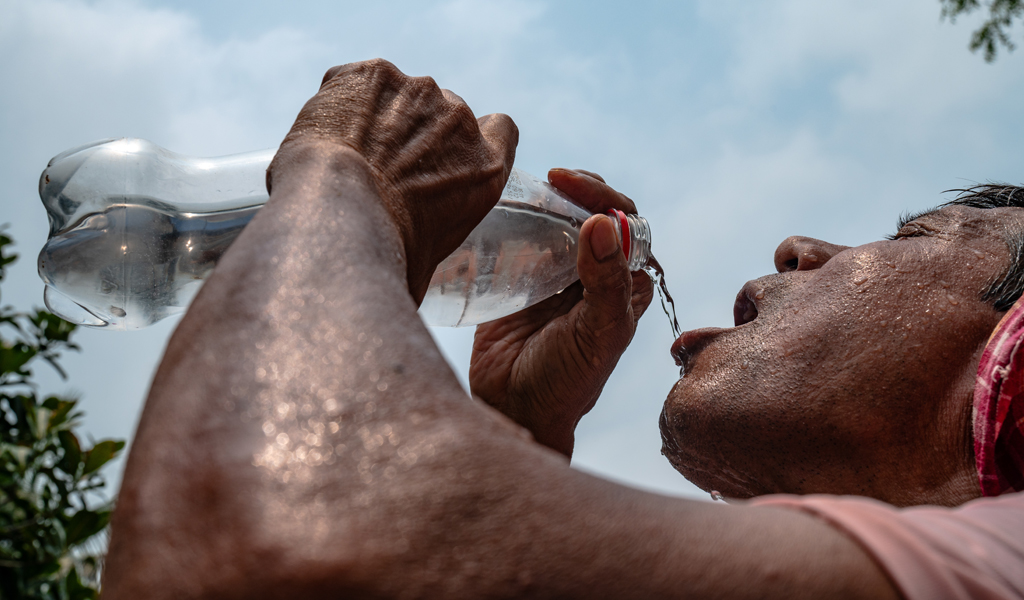
In 2023, some 700,000 deaths globally were associated with heat, according to the Lancet Countdown. The current El Niño is expected to push temperatures up over coming months, and could result in 450,000 deaths.
As we confront the reality that extreme heat is becoming a new norm, our work asks the question: who is actually able to act when the heat becomes dangerous?
Read more about our climate work
Many of the responses to extreme heat are technical solutions: better forecasts, cooling technologies, green space, air conditioning and early warnings. These are all important. But their benefits are not evenly distributed, and none of them operates outside the social and political conditions in which people live. Low-cost solutions are needed and possible.
Our work supporting the HeatNexus network of heat adaptation interventions, for example, is showing how practical, affordable and locally appropriate solutions, such as reflective roof paints, can protect the health of poor communities. Yet even these may also be difficult to apply to the very poorest, as roofs of their dwellings are unsuited to bear the intervention.
A heat warning is of limited use to an informal worker who cannot afford to stop working. Advice to stay indoors assumes that the home itself is safe in extreme temperatures. Access to cooling depends on electricity, housing, infrastructure and income. Greening neighbourhoods depends on land, investment and political choices about where resources are directed.
Exposure to extreme heat is partly meteorological. Vulnerability to heat, however, is also social, economic and political.
Understanding vulnerability, not just identifying “vulnerable groups”
At the Global Heat Forum, held in Bangkok in October, one recurring issue was the language of “vulnerable groups”. Categories of people such as older people, pregnant women or residents of informal settlements were repeatedly identified as vulnerable and at greater risk. It is of course a good thing that there was a concern for these groups. But categories alone tell us relatively little about why people are vulnerable, or what would enable them to respond.
Vulnerability is produced through overlapping conditions: economic precarity, political marginalisation, housing and forms of urban development, working conditions, gender, religion, health, caring responsibilities, and access to services and social protection.
Two of our current research projects (If Cities Could Speak and Urban Futures) examine dimensions of vulnerability in informal urban settlements and have repeatedly shown how risks accumulate in particular places and lives due to social conditions and processes. For example, a woman who is raising children alone after the break down of a relationship, living in a settlement in which does not feel safe but cannot afford to move from, complains she cannot sleep at night because her corrugated iron house is too hot but she will not open windows for ventilation for fear of robbery and intrusion.
Heat adds another layer to these existing pressures, and is not a separate hazard. Even ‘simple’ adaptations can be difficult to achieve in the face of these pressures.
That changes the question for policy. Rather than simply asking which groups are vulnerable to heat, we also need to ask what produces vulnerability, and what conditions intersect to prevent people from protecting themselves?
Without that understanding, interventions can inadvertently reproduce existing inequalities. Investments in cooling, green space or other forms of adaptation may be least accessible to the populations most exposed to heat. Heat action therefore needs to address not only temperature, but the conditions that determine who is exposed, who can adapt and who receives protection.
Better and context specific interventions, but also the ability to act
Early-warning systems show the limits of providing information or technical fixes that overlook vulnerability and capacity to act. At the Global Heat Forum, there was considerable discussion about moving beyond temperature forecasts towards impact-based warnings: information about what particular conditions mean for health, for particular populations and places, accompanied by practical advice. In cities, this needs to take account of the fact that heat is experienced differently between neighbourhoods, shaped by density, buildings, vegetation, airflow and infrastructure. For example, what does a pregnant woman living in a tin shack in a low lying and densely packed neighbourhood need to know and do?
But an effective warning system is not simply a better forecast. It is a chain connecting scientific knowledge with institutions, communication, public services and, ultimately, people with diverse capacity to do something differently. If any part of that chain breaks down, increasingly sophisticated information will not help.
Getting this right mean asking some practical questions. Who receives a warning? Do they trust it? Is the advice relevant to their circumstances? And does someone receiving advice actually have the resources, time and agency to act on it? And if not, are there institutions that could support or resources which could be accessed to unlock responses? These are governance questions as much as forecasting questions.
Making action possible across institutions
Making that warning chain work requires more than the health or climate sector alone. Protecting people from extreme heat must involve meteorological agencies, health systems, urban planners, employers, housing authorities, disaster-management agencies, social protection systems and communities themselves. Yet the budgets, evidence and accountability needed to connect these actors are often divided between them.
Experts at the Global Heat Forum raised familiar obstacles: unclear institutional responsibilities, competing priorities, inadequate budgets and difficulties coordinating across sectors and levels of government. Classification problems, such as how heat is defined within disaster, finance or insurance systems can determine what funding and other mechanisms become available.
The challenge, then, is whether institutions make action possible before and during periods of dangerous heat. Developing more interventions is only part of the answer. We also need institutional arrangements that connect warnings with protective action, and ideally in ways which build lasting not intermittent protection.
COP31: making protection possible for everyone
Taken together, these discussions point to a common challenge: heat protection depends on understanding what produces vulnerability, making warnings relevant to people’s circumstances, and connecting them to institutions and resources that enable action. These are not separate tasks. A warning cannot overcome unsafe housing or the need to earn a living, and identifying those at risk does not itself secure the support they need. As climate leaders and campaigners meet at COP31, growing recognition of extreme heat must therefore lead to more than a proliferation of plans, technologies and warning systems: it must change the conditions that leave some people unable to protect themselves.
We should improve heat data, forecasting and early warnings, and strengthen the evidence on which interventions work. But the value of that knowledge depends on who has the capacity to act, how responsibility is distributed between institutions, and who benefits from investment in adaptation. Success means not only anticipating dangerous heat, but making protection possible for those who cannot secure it alone, and building that protection into everyday working conditions, housing and public services rather than treating it as an intermittent emergency response.