
Indonesia arrives ‘hot’ to COP31 this week, bringing the theme ‘Delivering Climate Solutions at Scale’ to the forum. Yet the reality at home indicates otherwise. While presenting climate solutions on the global stage at COP, the government has failed to protect Indonesians at home from climate hazards.
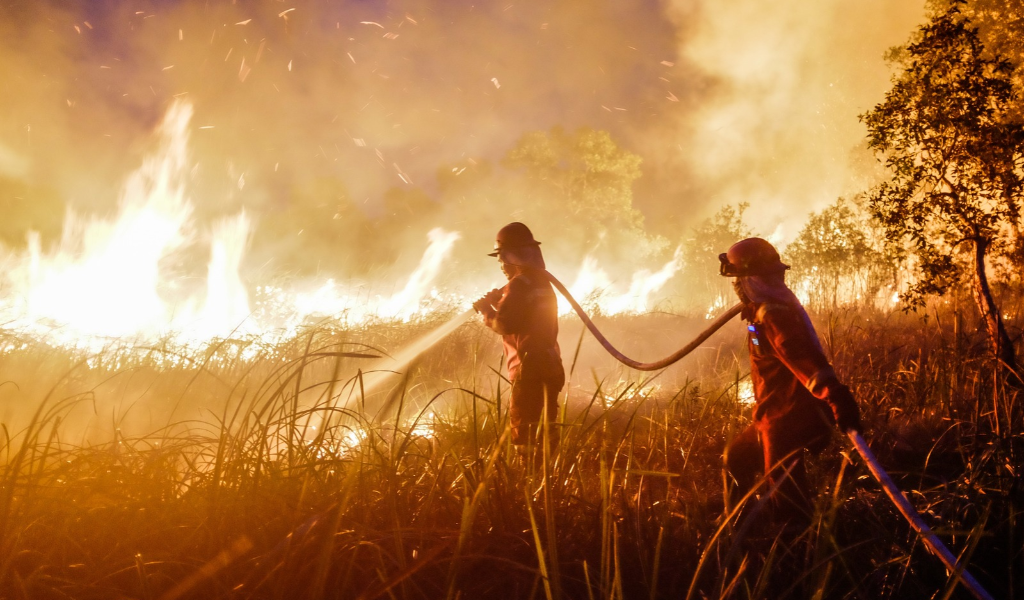
For over two months, forest and land fires have been burning in Indonesia with no sign of subsiding, consuming 1.9 million hectares and causing economic losses estimated at Rp 167 trillion. The country has become a sea of fire, with Kalimantan, Sumatra and Papua particularly affected.
However, the damage is not only financial. An estimated 40 million people across Kalimantan and Sumatra have been living under a blanket of smoke that, according to the Ministry of Health, has triggered more than 300,000 cases of acute respiratory illness due to unhealthy air quality levels Neighbouring countries, such as Malaysia and Singapore have also been impacted.
Governance reform and paradigm shift
This raises the question: where has the government been? And why have forest and land fires become a recurring disaster cycle across successive political regimes?
The United Nations Office for Disaster Risk Reduction (UNDRR) recently launched the #NoNaturalDisaster campaign, which conveys that hazards might be natural, but disasters are not. Disasters relate to governance and state capacity. Looking at policy records and the recent government response in Indonesia, the fires are a result of government incompetency to prevent a hazard that led to the fires.
As a country vulnerable to hazards, Indonesia should be improving its infrastructure and institutions to prevent and mitigate from hazardous events. The current fires serve as a wake-up call for the government to invest more in the disaster and environmental sectors.
Political choices are deeply implicated in the emergence of disasters. Through the lens of political ecology, environmental disasters emerge from the interplay of social, economic and political forces that determine who bears the risk. Governments have the power and the resources to decide and to act.
In Indonesia, however, rapid political transition and escalations tend to produce populist policy choices, and disaster and climate governance are rarely among them. As a result, when hazards strike, the government is invariably slow to respond. The consequences? Affected communities and wildlife are displaced, and some lose their lives. This is nothing less than a failure of the state to carry out its public functions.
In response to the 2015 forest and land fires, the government created the Peatland and Mangrove Restoration Agency (BRGM), but it was dissolved in 2025. In 2026, amid another wave of devastating fires, the government re-established the Peatland and Mangrove Management Agency (BPGMN). However, reviving the agency is not enough without reformation of the political economy that shapes environmental management in Indonesia.
Reform of disaster governance is overdue, demanding a shift in political paradigm: from egocentric to the ecocentric. For this to happen, political will is key.
Deaf to the risks: invest more in disaster and climate resilience
The government has been dangerously insensitive to risk. As early as March 2026, the National Research and Innovation Agency (BRIN) warned that a ‘Godzilla’ El Niño was on its way, and the warning went unheeded. The central government cut the budget of the National Disaster Management Agency (BNPB) to pay for other populist priorities, notably Free Nutritious Meals (MBG) programme, leaving itself poorly equipped to respond. On top of this, officials stand accused of corruption over the emergency fund for forest and land fires. When the fires spread on a massive scale, the government was left scrambling.
This is not to say the government has been idle. Considerable effort has gone into tackling the fires, through regulation, funding and personnel. However, much of it would not have been necessary if the government had been more alert to the climate and environment and guided by science and technology. Indonesia does not lack experts or money, but the will to prioritise prevention. What it needs, first, is sensitivity to risk, and second, a stronger state capacity for disaster and climate governance. Together, these would give the government a firm foundation for running a country so vulnerable to such hazards.
As Indonesia holds one of the world’s largest tropical peatlands, covering 13.43 million hectares and storing an estimated 57.4 gigatonnes of carbon, it should treat that asset with far greater care and awareness. Peatland governance, restoration and protection must be strengthened continually, with greater investment in technology and in people. Research has found that peatland restoration helped to reduce fires during the 2019 El Niño.
Communication, openness and empathy matter
The central and regional governments are trading blame over the fires. During disaster, Indonesia’s leaders are still staging political theatre, putting their mismanagement and misaligned policies on public display. Worse, public officials have made statements that lack empathy and expose their unfitness to lead. For example, the Head of Indonesia’s Government Communication Agency (BAKOM) stated, “We do not just send smoke; when there is no smoke, we send oxygen.”
Communication in a crisis is often treated as an afterthought, yet it is integral to disaster response. In an age of pervasive digital communication, the public must receive accurate and reliable information – a considerable challenge for a government contending with a flood of disinformation and misinformation on social media. Disasters are profoundly social events, not merely climatic ones, and social media is a powerful arena in which they are communicated and contested.
In disaster response, then, narrative designed to win political approval has no place. What the state needs is a strong capacity for communication, grounded in openness and empathy.
What COP31 must deliver
World leaders must treat ecological disasters as a turning point and a moment for genuine reflection. They must turn uncertainty into measurable risk, and risk into concrete policy and action. The ecological disasters and climate crisis unfolding in Indonesia should be a global concern and prompt a full review of existing pledges.
As a country that is both vulnerable and rich in natural resources with clean and renewable energy potential, Indonesia must become a leading voice on ecological and climate problems and turn its sustainable development agenda into real action. After years of chaotic policymaking that has damaged nature, the Indonesian government must strengthen its policies and consolidate efforts nationally to put climate and disaster governance in order. Global climate diplomacy must be built on strong national institutions and capacity. Slogans and rhetoric will not save the planet. Only collective action will.
To the volunteers battling the flames on the front line, you have carried our hopes, our prayers and our support. May you stay safe and well, and may you return home to your families. To everyone affected by the disaster, we wish you strength and good health as you endure this ordeal. Finally, to the government – please get your house in order and do so without delay. Look clearly, act with conscience and judgement. Use the power you hold for the many, not the few.
May Indonesia heal soon.
Interested in learning more about the MSc Climate Change, Development & Policy? Find out more: