Former Chief Election Commissioner of India, S.Y. Quraishi, criticised the state of the country’s democratic institutions while speaking at the Institute of Development Studies (IDS). His comments come amid intense protests across India over electoral rolls. He warned that public trust in India’s Election Commission is at stake.
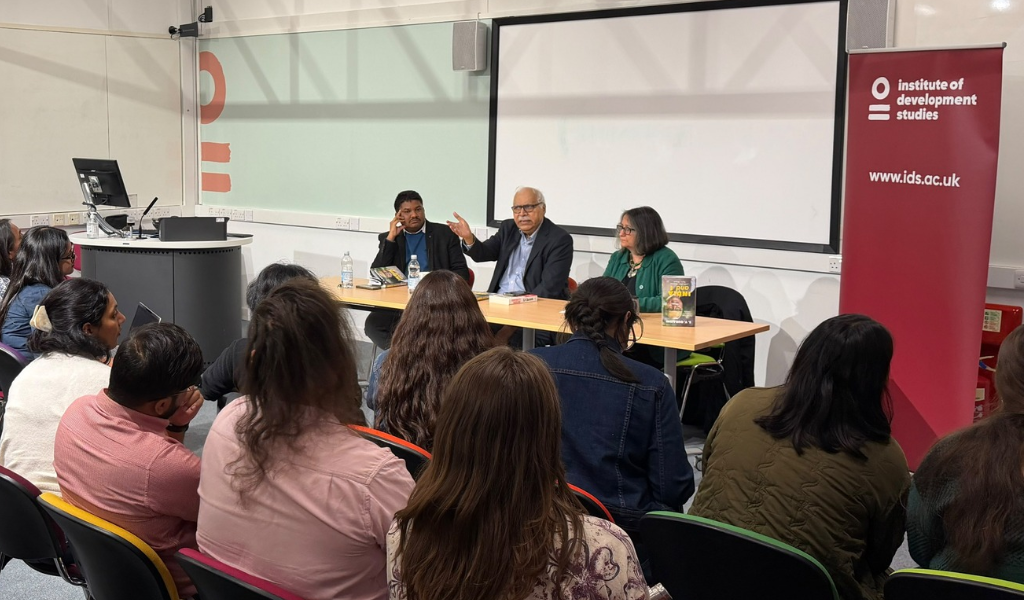
Addressing an audience at IDS on 22 October, Quraishi said: “They [The government of India] have murdered our democracy, but I have hope that it will bounce back. We have a very resilient democracy.” He continued to say that “We have the most powerful, effective, trusted and credible democratic institutions in the world” but that he feared it was now “in the pit.”
India’s Special Intensive Revision (SIR)
The protests in the world’s largest democracy have been over India’s Special Intensive Revision (SIR) of electoral rolls. Initially launched in June 2025, SIR has left 61.5 million of voter names off draft rolls in the latest phase, which covers 16 states and three union territories. This has led to widespread demonstrations in India with protestors demanding a new election commission chief.
Drawing on his experience leading the Election Commission between 2010 and 2012, Quraishi argued that the credibility of electoral institutions depends on their independence from political influence and their accountability to the public. “We should have a correct, and not a cosy relationship with the government.”.
In the first phase of the SIR, Delhi and Maharashtra draft rolls show a cut of 32.8 percent and 21.1 percent of adult voters respectively. In Uttar Pradesh, more than 17 percent of the adult population has been left out of the list and now unable to vote in future elections. This has led to youth-led mass protests where protesters have called for the removal of Chief Election Commissioner, the scrapping of the SIR and the restoration of eligible voters’ names to electoral rolls.
The right to protest
The protests have also raised concerns about the state’s response to dissent. The protestors have been met with police brutality and detention over the last few days. Several news outlets have reported that New Delhi was under siege with deployment of more than 20,000 police and paramilitary personnel, and the central government’s suspension of internet access. More than 7,000 people have been detained by the police, including leaders from India’s opposition parties, lawyers, and journalists.
In his discussion, Quraishi raised concerns about the impact of voter deletions through SIR on minority communities in India. “The bias was very clear, remove all Muslims.”
Asked whether the SIR amounted to implementing the National Register of Citizens (NRC) through the back door, Quraishi responded: “My answer is this is not NRC from backdoor, but from the front door.” He alleged that Muslim communities were being disproportionately targeted, adding that “80 percent of villages with Muslim voters were removed. Muslims were the number one target but also non-Muslims who were voters from other political parties.”
India’s democracy
When talking about the Constitution of India, Quraishi said that the right to vote cannot be separated from the wider question of democratic participation. Where eligible citizens are unable to register or exercise their franchise, the consequences extend beyond an individual election to the legitimacy of the democratic process itself.
Professor Anuradha Joshi, Director of the Institute of Development Studies, emphasised the value of understanding the experiences behind decision making in how to conduct elections, including the political negotiations and institutional processes that shape policy and governance – the realpolitik. She also pointed out that Dr. Qureshi’s talk highlighted how robust research can help shape good policies.
The event was hosted by the Brighton Ambedkar Reading Circle, in collaboration with the Association of Ambedkar Societies (UK) and IDS.