


Amidst a turbulent time for democracies globally, a lot of media attention is paid to the big expressions of popular will and potentially pivotal political moments. For example, elections in Brazil, Serbia, the United States and elsewhere in the world have been closely watched as the bellwethers of the future of democracy. Mass demonstrations of political opposition, whether the wave of protests across Europe, or the mobilisation of Gen Z activists around the world, also capture headlines, with dramatic scenes of ‘people power’.
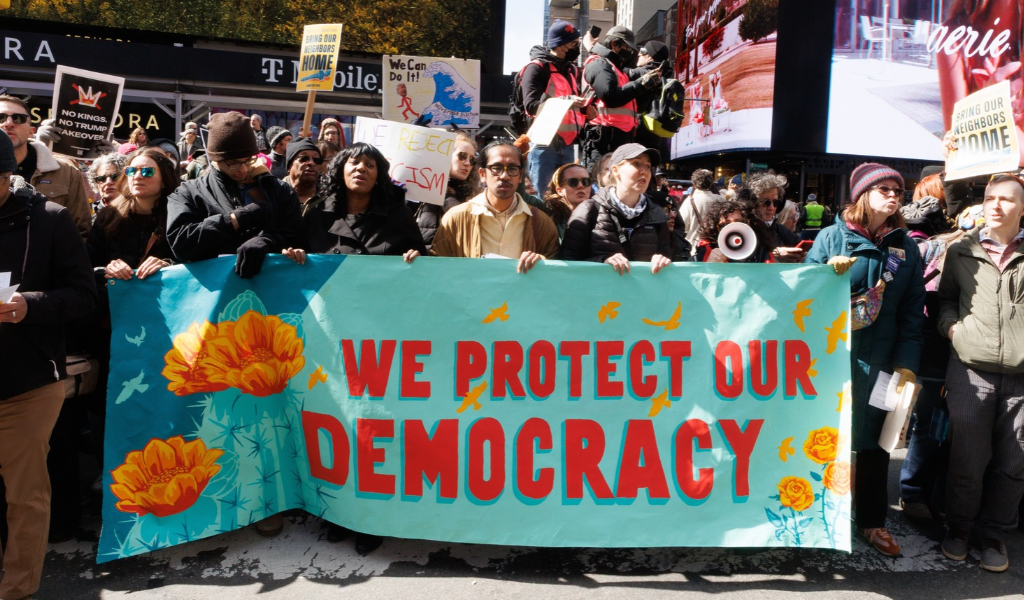
Underpinning much of this attention is the hope for change – that the power of the state can be (re)directed to long-standing injustices and grievances, challenging the status quo. But while elections, mass demonstrations and other ‘big’ moments are emotive and potentially consequential, they are only a part of the story. Equally important is the everyday democratic work of citizens organising, advocating and holding institutions to account. This kind of everyday contestation – the long-haul advocacy, grit, and determination to make the state work for its citizens – is at the heart of our new publication for the Grassroots Justice Network, a global community of individuals and organisations that help communities know, use and shape the law.
The report – Making Institutions Work: Strategies for Engaging the State through Legal Empowerment – draws on the multi-year research journey of 17 legal empowerment organisations across Africa, Asia, and Latin America, undertaken in partnership with Canada’s International Development Research Centre.
It spans citizen-led action to address a range of challenges, from environmental degradation, discrimination of marginalised communities and barriers to housing and public services in informal settlements. In addition to the outputs of their action research, facilitated discussions, and interviews, our analysis draws on a set of ‘strategy stories’ shared by the organisations. At its core, the paper asks: How can communities build enough power to engage the state on more equal terms – and how can that engagement contribute to more responsive institutions and stronger democracy?
Diverse strategies to make the state work for justice
Many of the strategy stories do describe protests that challenged the state or corporate actors. From direct action against exploitative companies to public demonstrations and vigils in other cases, these tactics made problems and the strength of public anger against them more visible – raising the costs of inaction for state institutions. In Sumilao, the Philippines, indigenous villagers working with the the Alternative Law Groups coalition, not only reclaimed their ancestral lands from damaging industrial concessions but also catalysed progressive land reform legislation. Their story centres on their highly visible demonstrations and petitioning of government. Other organisations similarly emphasised the importance of using direct action to ‘show you have the numbers’.
But none of the stories were solely about these more confrontational or high profile moments, and some eschewed them altogether – particularly in contexts where the threat of state repression or potential backlash against minorities was high. Direct action is only one of the ten approaches our collective research identified across organisations. These ‘big bang’ moments were underpinned by the less visible, day-to-day work of finding ways to make the state work for justice.
Equally important was the quieter, sustained work of advocacy: working with communities to gather evidence of injustices, using the law, oversight bodies, and international agreements to keep governments honest, and building alliances, both within and outside the state. For example, in Buenos Aires, Argentina, the organisation Asociación Civil por la Igualdad y la Justicia (ACIJ) and residents of informal settlements used years of organising, evidence-building and advocacy to allow them to shape decisions about their neighbourhood’s future. Their sustained efforts not only forced greater consultation from the government but helped to open up the possibility of cleaning up and redeveloping the neighbourhood rather than relocating its residents. The daily work of democracy is not always about challenging the state, though. Sometimes it is about helping institutions to do better. In Malawi, the organisations the Centre for Human Rights Education Advice and Assistance and the Southern Africa Litigation Centre worked with local police and the policing ombudsman to tackle arbitrary and exploitative arrests of street children, sex workers, and LGBTQIA+ people. Key in this was starting dialogues between authorities and those groups, bringing frontline police officers face-to-face with communities to understand the effects of over policing and over time, build more understanding relationships.
Building power for democratic and just futures
The practice of democracy is also about solidarity. Building protective and supportive alliances with others, nationally and internationally, with and outside of the state, is a crucial part of the ‘groundwork’. The strategy stories show immense nimbleness in using these relationships to develop messaging and framing that resonates with different audiences and mobilise in political moments when demands are most likely to gain traction.
Perhaps the most important lesson from these stories is that empowering and equipping ourselves to organise and challenge injustice is not easy, and it is not quick. It requires staying power: the ability to dig in, hold course, and bide time. Across the stories we gathered, progress often came through years of persistence and tenacity, adapting strategies to setbacks and changing circumstances, and a grounding in ongoing community action and power-building.
Compared with the hype of the election of the week, or the dramatic scenes of popular protest and state repression, these often quieter, long-haul campaigns might not seem seismic. But they are as much of the work of democracy-making as spontaneous eruptions of dissent. Good change isn’t only – or perhaps even usually – seismic. In the face of growing authoritarianism and restrictions on civic space and freedoms, it is just as important to understand and support ‘everyday resistance’. The Grassroots Justice Network members – any others like them – are a source of inspiration for that.